Bring back human-centered classrooms.
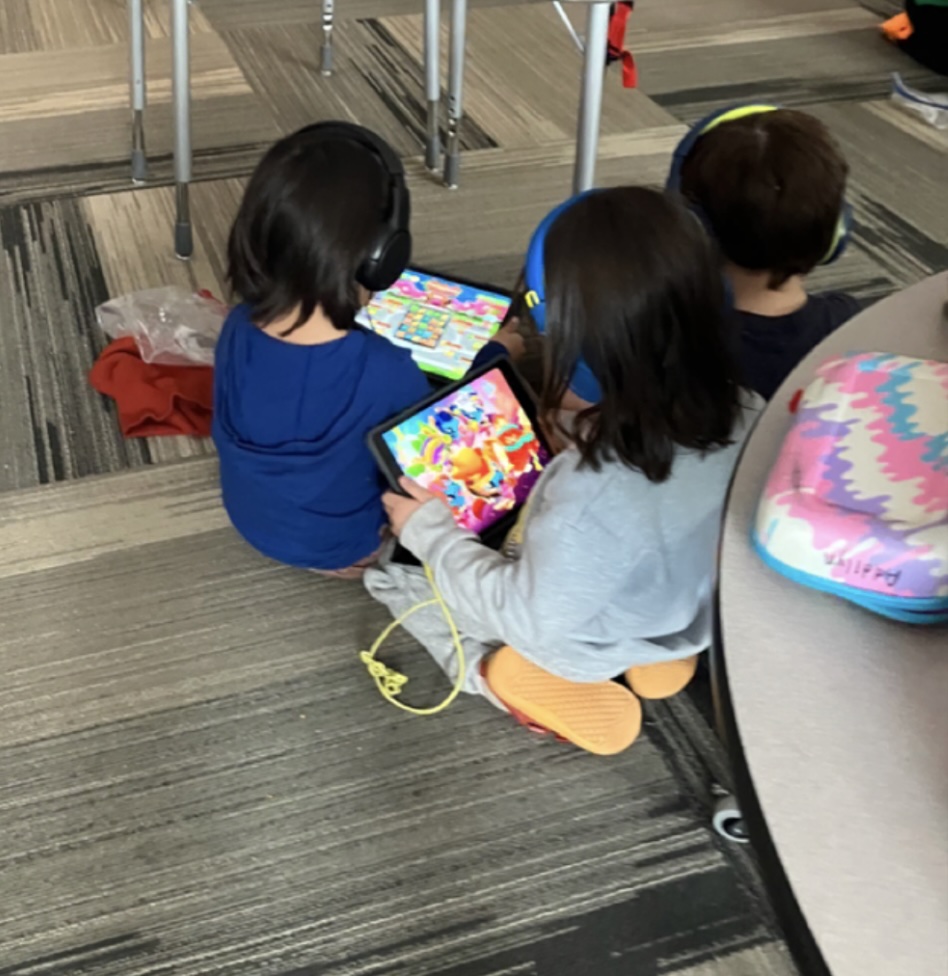
Why are our classrooms filled with silent children sitting in front of iPads and Chromebooks with their headphones on? Every minute in front of the screen is a minute where their brains are shaped by short, fragmented content and constant hits of dopamine. Alaska's reading and math scores are second-to-last in the nation, and there is hard evidence that tech in the classroom sets our kids back even farther.
"During my days volunteering in the classroom, a kindergartner had a breakdown when he was asked to do his worksheets before his iPad time, screaming, 'I want my iPad back! Give me my iPad back!' Later, he rolled around on the ground and sobbed, 'This is boring! This is boring! I don't want to be here!'" — Classroom observations from Alice Rhee, Fairbanks North Star Borough District
Dissecting the problem
International assessments show a similar relationship across students of all ages worldwide: higher daily screen exposure consistently corresponds to lower scores in reading, mathematics, and science. These datasets are extremely robust and all point to the conclusion that heavy classroom screen exposure is not improving learning outcomes at scale. Researchers have also begun to correlate the adoption of devices in schools with falling test scores worldwide, a decline that began well before COVID in 2012.
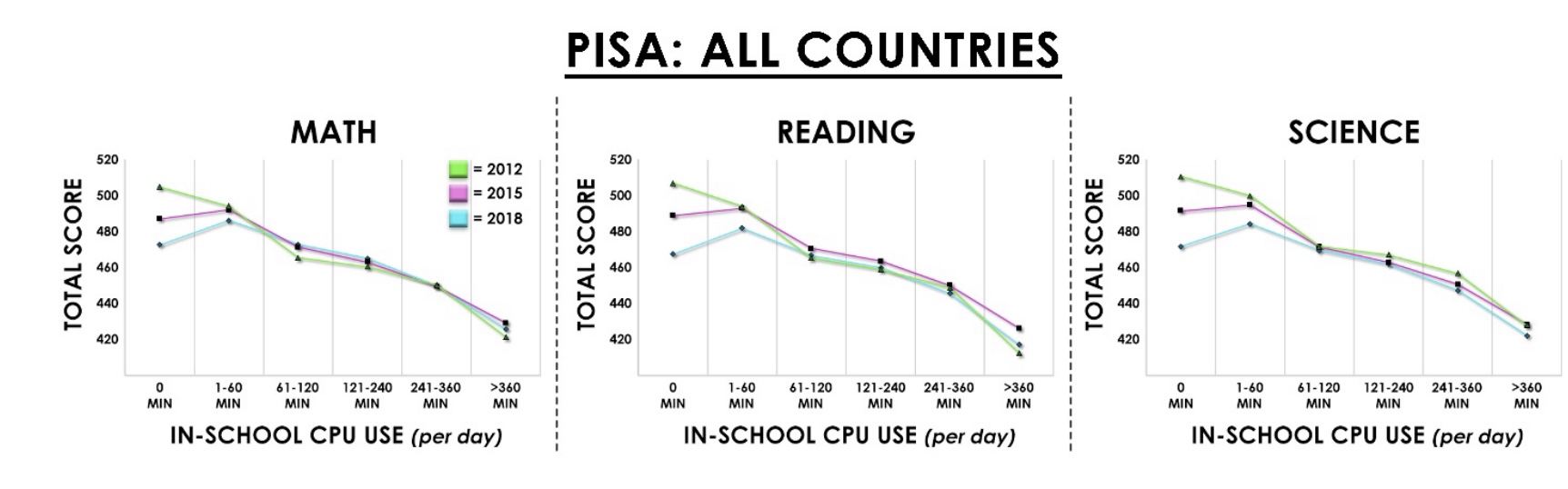
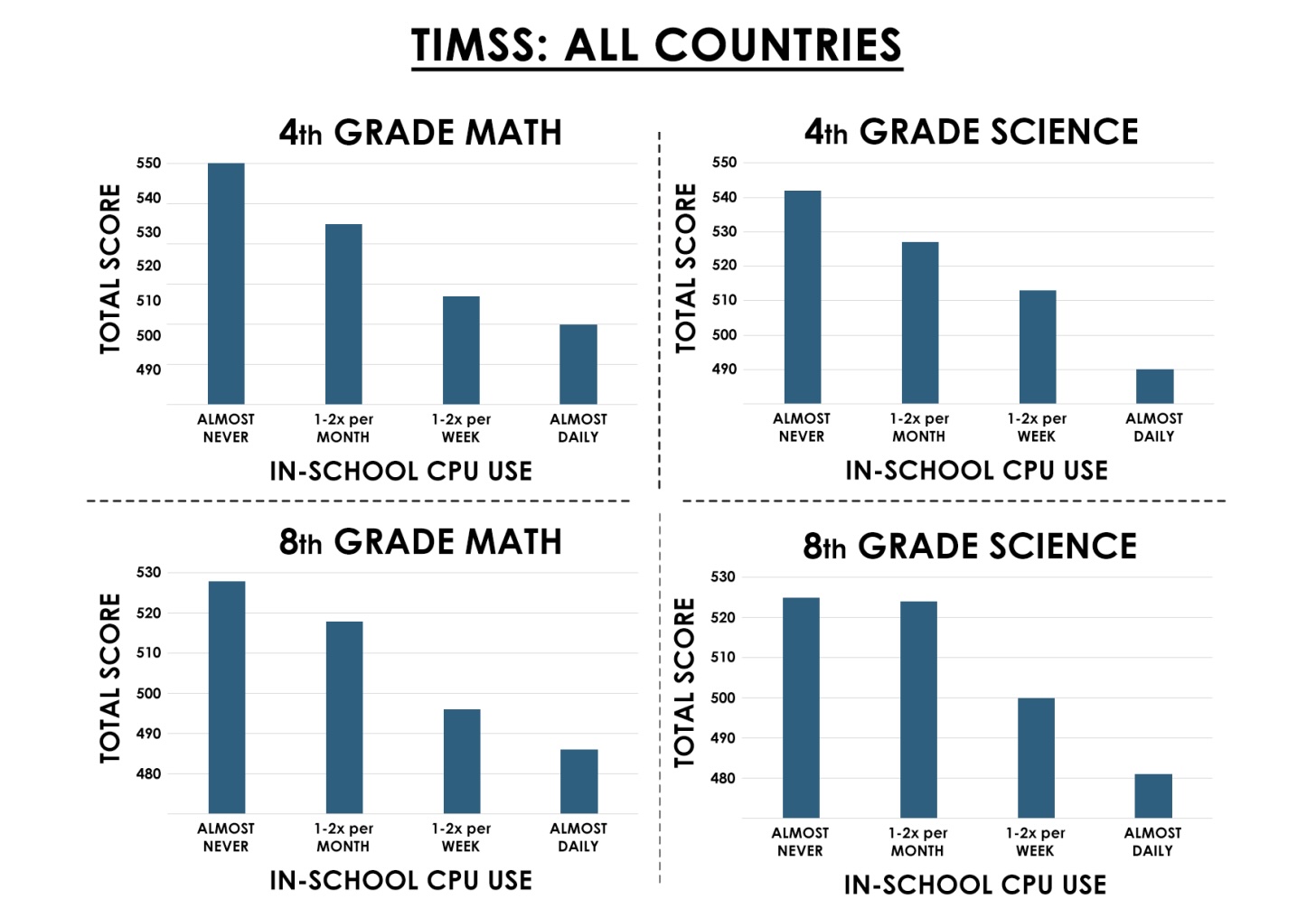
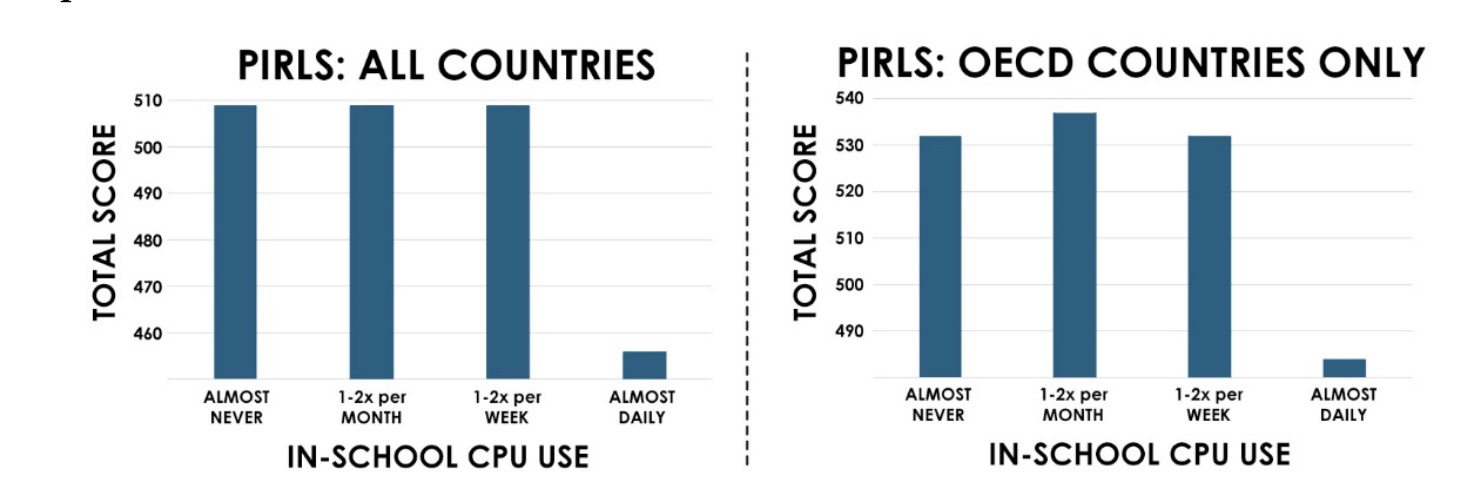
A large scale synthesis of educational research shows that when benchmarked against the efficacy of established analog classroom methods, almost all digital interventions were less effective. The following digital interventions are significantly less effective than analog methods:
- 1:1 device programs
- Fully online instruction
- General classroom technology integration
- Programs targeting disadvantaged populations
Handwritten note-taking reliably outperforms laptop note-taking for long-term learning, and there is so much evidence that we understand and retain less when reading text on a screen that this phenomenon has its own name: the screen inferiority effect.
These independent studies stand in contrast with the research studies commissioned by EdTech companies themselves. It's not a new move to see companies funding research to shape the evidence base for their own benefit. When Coke funds research on physical activity rather than the impacts of drinking 39 grams of sugar, the resulting data distracts from the true addictive qualities of their products. Big Tobacco also strategically funds research to serve their interests, a practice that continues today with vaping and e-cigarettes. We're in the midst of a slow public reckoning with technological harms only after our kids have already been affected.
By integrating tech into the classroom and giving 1:1 devices to students, we are pursuing a path that is less effective than when kids were reading real books, writing on real paper, and doing project-based learning. Tech, when used, should be intentionally chosen as the best option for a specific problem, not used simply because it's there.
Rather than focusing developing critical thinkers who can understand murky contexts, we're just churning out consumers. Kids with fragmented attention spans who seem "engaged" and hooked on a product, who are excellent fodder for companies and bad for our society. Kids who haven't practiced the "productive struggle" needed for true learning and healthy human relationships.
Let's break this down. EdTech apps like Boddle and Prodigy are privately owned companies. They need to show evidence of revenue, market expansion, and growth to investors, creating pressure to increase subscriptions, maximize "engagement," and aggressively enter school systems. Tactically, that means that they will tend to prioritize gamification features, will be incentivized to collect more valuable student data, and will emphasize learning metrics that are simple to quantify and easy to sell. Skills like creativity, curiosity, deep reading, critical discussion, and social-relational learning are difficult to quantify and do not get prioritized.


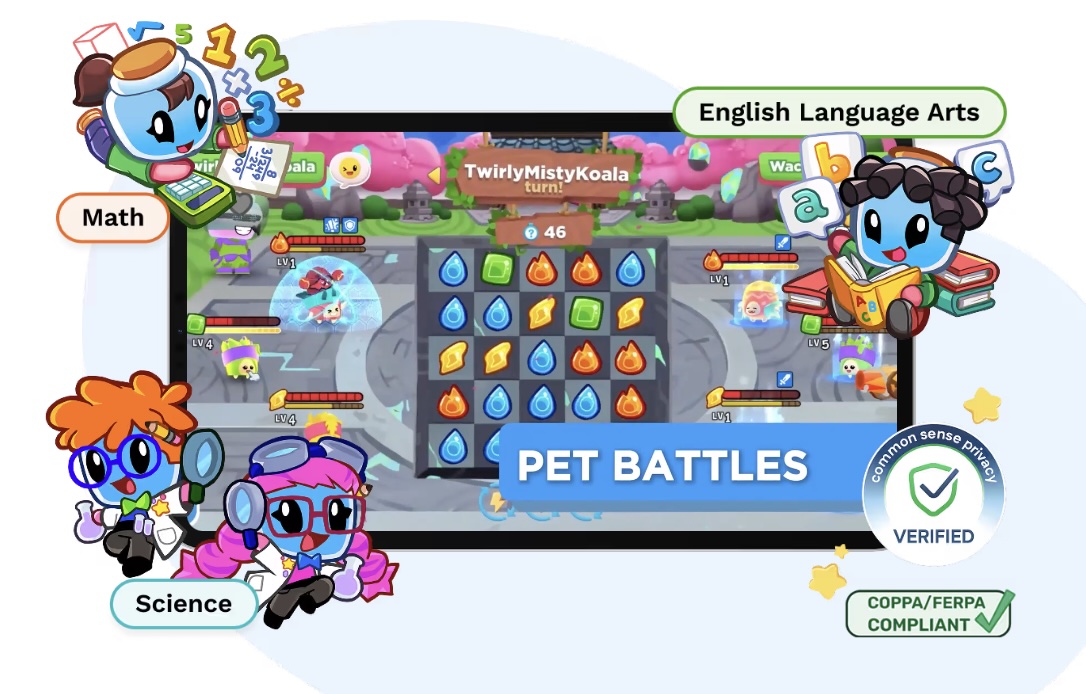



Apps like these rely heavily on addictive engagement systems like rewards, cosmetic upgrades, streaks, pets/avatars, etc. Compare the intricate effort that's been put into these games vs. the simple learning questions in the images above. Take 10 min to watch your kid play one of these. It's very clear that it's a game first, learning tool second. When students seem "engaged" with the games, it seems to demonstrate to educators and parents that the cost of purchasing a subscription was worth it. And unlike public curricula, proprietary systems don't have to fully disclose things like their adaptive-learning algorithms or methods to ensure efficacy, making this a black box.
Once a tech purchase is made, schools / districts often feel locked in and resistant to change, even when that change would greatly benefit the students they purport to serve. This is especially the case when schools purchase classroom management software from private tech companies, port their data in, and become tied to that vendor's ecosystem.
We're sacrificing our children's brains to line the pockets of tech company CEOs.
If promoting screen-free classrooms sounds uncomfortably close to something a tech naysayer would say, then consider the fact that tech leaders and CEOs (the definition of technology advocates!) avoid giving their children heavily tech- and screen-enriched experiences.
Tech billionaires and CEOs severely limit their children's exposure to iPads and screens. In 2018, Snap CEO Evan Spiegel (makers of Snapchat) said he limits his child to 1.5 hours per week(!) of screen time. Apple cofounder Steve Jobs told a New York Times reporter his kids had never used an iPad and that, "We limit how much technology our kids use at home." Jony Ive, the highly revered designer of the iPad, implemented strict limits on it for his young sons–these same tablets that reside casually and unquestioned in our school classrooms!
Tech leaders also do not send their children to schools where tech is interwoven in the classroom experience. Waldorf schools, which strictly avoid screens in the classroom before the age of 12, are particularly popular with Silicon Valley executives and employees. The chief technology officer of eBay sent his children to a nine-classroom Waldorf school in the Bay, and so do employees of Google, Apple, Yahoo and HP.


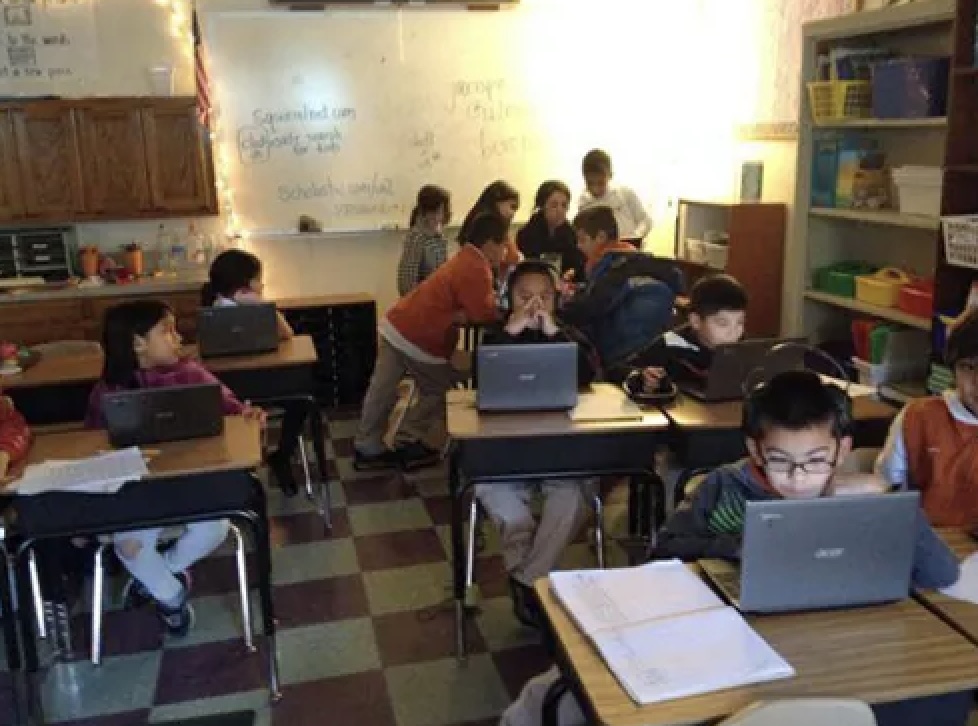
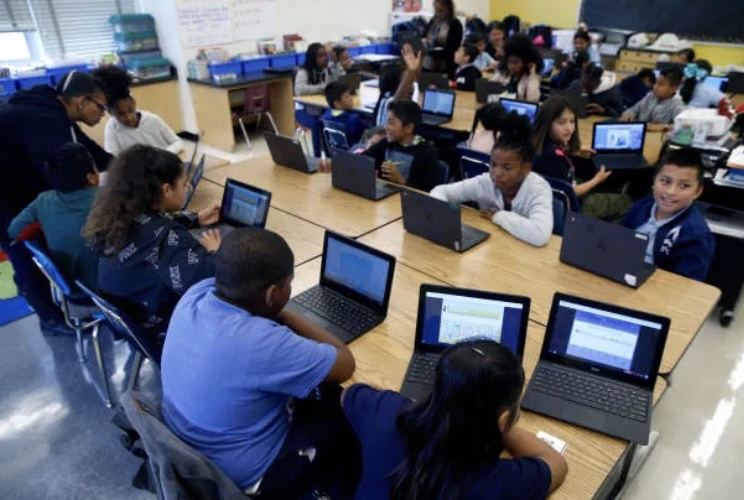
Consider that 88% of American public schools follow what's known as the 1:1 policy, providing one laptop or tablet for every student — a policy that makes Big Tech enormously profitable. Although Google and Apple appear to altruistically lose money through educator discounts, once a school adopts their devices, it turns into a self-sustaining cash cow, generating users highly likely to stick with the brand. If customer retention rate increases by only 5%, company profits can increase by 25-95%! The younger the user, the more lifetime value they generate.
But there's simply no good reason for a 1:1 model versus a computer lab model where students have a weekly "computer skills courses" similar to PE or music, or a shared laptop cart that teachers can reserve for a specific purpose. Each of these removes temptation from students and from teachers who, exhausted and underresourced, may end up using the iPads for classroom management purposes in order to get some quiet in the classroom.

The idea that our children are predisposed to learn from screens arises from the myth of the "digital native," or the idea that those born after a certain time period are innately digital, with natural multitasking abilities and fundamentally different cognitive processing. This narrative was regularly wielded by EdTech advocates to justify retooling the classroom; however, it was soundly debunked back in 2017. Our children have the same brains as we do. While they may want the screens in the classroom, they do not innately need them. It’s true that digital literacy is important for workforce development, but neither mere exposure to digital technology nor gamified learning inherently equips students with this skill.

When schools simply allow kids to get quick hits of dopamine all day, learn in a context where distractions are a click away, and ingrain gamified patterns into their neural pathways, their brains are physically shaped by this and not by what deep focus feels like. It feels delusional that we could think otherwise when considering our own lived experience as adults. The itch to check our email 17 times a day. The likes on social media. The discomfort when the phone is accidentally left at home. Our vulnerable kids aren’t magically wired for tech. Analog childhoods best prepare kids for digital futures.
This is a structural problem and not an individual one, caused by an underinvestment in the humans who can best help our kids learn. In a 2025 survey, a third of parents who utilized screens at home did so because they could not find childcare: If they had another human around to help, they wouldn’t necessarily have turned to the screen for their child.
This is congruent with what I observed in my week of volunteering in my son’s kindergarten classroom. When there were three adults, the student:adult ratio shrank from 11:1 to about 7:1, and it was much easier to manage the class and provide extra support to students who needed it. My son’s teacher was able to pull off structured learning activities, like learning about symmetry while painting butterfly wings. During an iPad-less free time block, I watched the kids do dance routines, make their own crafts, build train tracks, and order bizarre pizza combinations with each other using a fake telephone. The time felt grounded and fulfilling.

In the long term, re-centering our teachers can draw students back into our public schools. If students come home full of chatter about how much they love their teachers instead of talking about the bosses they beat or the coins they earned, parents will take note; this can meaningfully how folks feel about our public schools.
What we're asking for
We want our local school districts (Fairbanks North Star Borough, Anchorage, etc.) to take action on the following changes for the 2026-2027 school year.
Our three demands:
- Formalize a Tech Opt-Out Policy — Our children shouldn't be denied a public education because we want them to have the option to read books or interact with others instead of staring at a screen for hours a day. There's zero large-scale evidence that general classroom tech improves learning.
- Create a Tech Use Task Force — We want intentional, purposeful tech usage—not just tech for the sake of tech. Conduct a tech audit and codify what our values are. Develop and publish a tech usage philosophy with clear, defensible, data-driven guidance on when, why, and how digital tools will be used in support of these values.
- Ban Screens from Grades K-3 — There's no need for screens in early education. Five-year-olds don't need iPads as soon as they enter public school. They need human support. Decouple daily device use from the need to take standardized tests online, as a visit to a computer lab would suffice.
"We have evolved biologically to learn from other human beings, not from screens, and screens circumvent that process … It doesn't matter what the size of the screen is–if it's a phone, if it's a laptop, if it's a desktop–and it doesn't matter if it's school sanctioned. All of these things are going to hurt learning." — Senate testimony, Dr. Jared Cooney Horvath, neuroscientist
How we got here
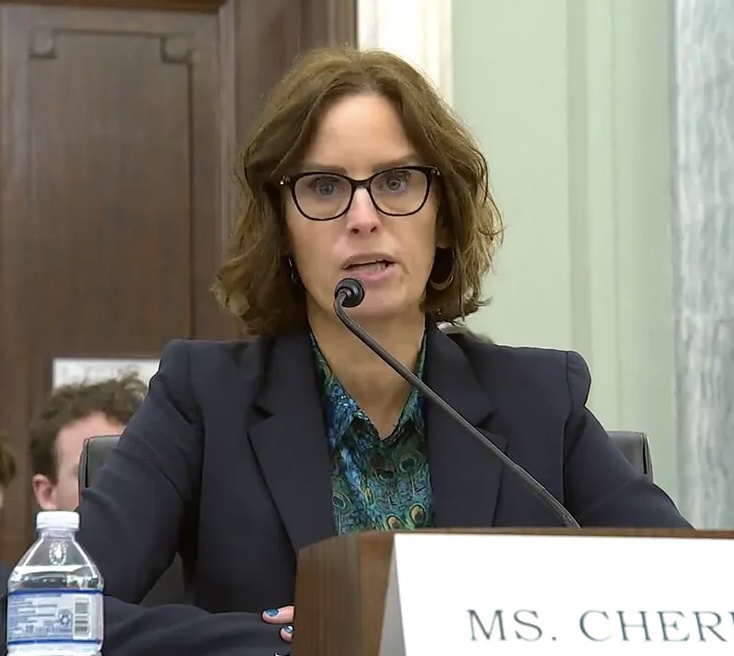
Emily Cherkin, screentime consultant, testifies to the U.S. Senate about the impacts of tech on mental health, learning, creativity, and democracy.
Dr. Jared Cooney Horvath, neuroscientist, also testifies on how the rapid and largely unregulated expansion of edtech is related to kids' cognitive decline. Gen Z is the first generation to underperform their parents on every cognitive measure.

The second largest school district in the U.S. (Los Angeles Unified) votes to restrict screen time in schools.
The President of the American Federation of Teachers calls for limits on AI and screen time in schools.
The U.S. Surgeon General issues an advisory warning of the harms of screen use on children's health and development.
Alice Rhee, tech researcher, testifies to the FNSBSD on how her son changed after going from no screens at home to daily screens in the class and her insider awareness of how tech companies actively seek to make usage irresistible.

The 2026-2027 school year begins, and with it, the chance to enact meaningful change for our kids.
Additional Resources
Toolkits & Books
- EdTech Opt Out ToolKit — Emily Cherkin - stats and concrete resources for parents who want to opt out
- The Digital Delusion — Dr. Jared Cooney Horvath - multiple actionable templates for educators, parents, and policy-makers
News & Analysis
- Youth Tech Policy in 2026 — Whiteboard Advisors (02/26) - analysis of 2026 tech policy trends
- The Ed-Tech Backlash Is Here — Education Week (04/26) - analysis + survey of teachers, principals, district leaders
- Philadelphia schools rethink edtech — Associated Press (05/26) - tensions between parents and districts
- How Google Conquered the American Classroom — The New York Times (05/17) - reporting on how it's lucrative for Google to get their devices in classrooms
- What Happened When Teachers Ditched Screens — The Atlantic (04/26) - feature on classrooms that went screen-free and what changed
Research & Policy
- Digital Ecosystems, Children, and Adolescents: Policy Statement — American Academy of Pediatrics (02/26) - outlines how engagement-based designs might undermine children's well-being
Local Materials
- Letter to the FNSBSD — Alice Rhee - focused on ways Edtech companies wield deceptive research and tech company incentives
Who we are

This initiative was kicked off in May 2026 by Alice Rhee of Fairbanks, AK. With over 10+ years of experience as a UX researcher for Silicon Valley tech companies like Twitch and Mozilla Firefox, she could clearly see how Big Tech companies benefit from having kids hooked on their branded devices in the classroom and the long-term neurological and data privacy harms that entailed.
Her husband, a teacher with over 21 years of experience, had also observed distressing changes in his students' attention spans, mental health, and critical thinking skills over the years.
When her kindergartner began compulsively seeking out any game-like experience he could find at home after playing gamified "learning" apps on his classroom iPad daily, she decided to try and share the impacts of tech on children's brains and the big money at play beneath the surface. It's her goal to advocate for the benefit of all kids in our neighborhood schools instead of disengaging from the public school system.
Ready to add your name?
Every signature makes our case stronger. It takes 30 seconds!
Sign the petition